In the automotive refinishing business, "perfect" isn't a subjective term—it's measurable. It’s the absence of dust nibs, fisheyes, and orange peel.
Most shop managers focus on the spray gun brand or the clear coat quality, but they overlook the single biggest factor controlling the finish: Airflow. You can have the best painter in the world, but if your booth is recycling 10-micron particles onto a fresh hood, you are burning money on buffing and reworks.
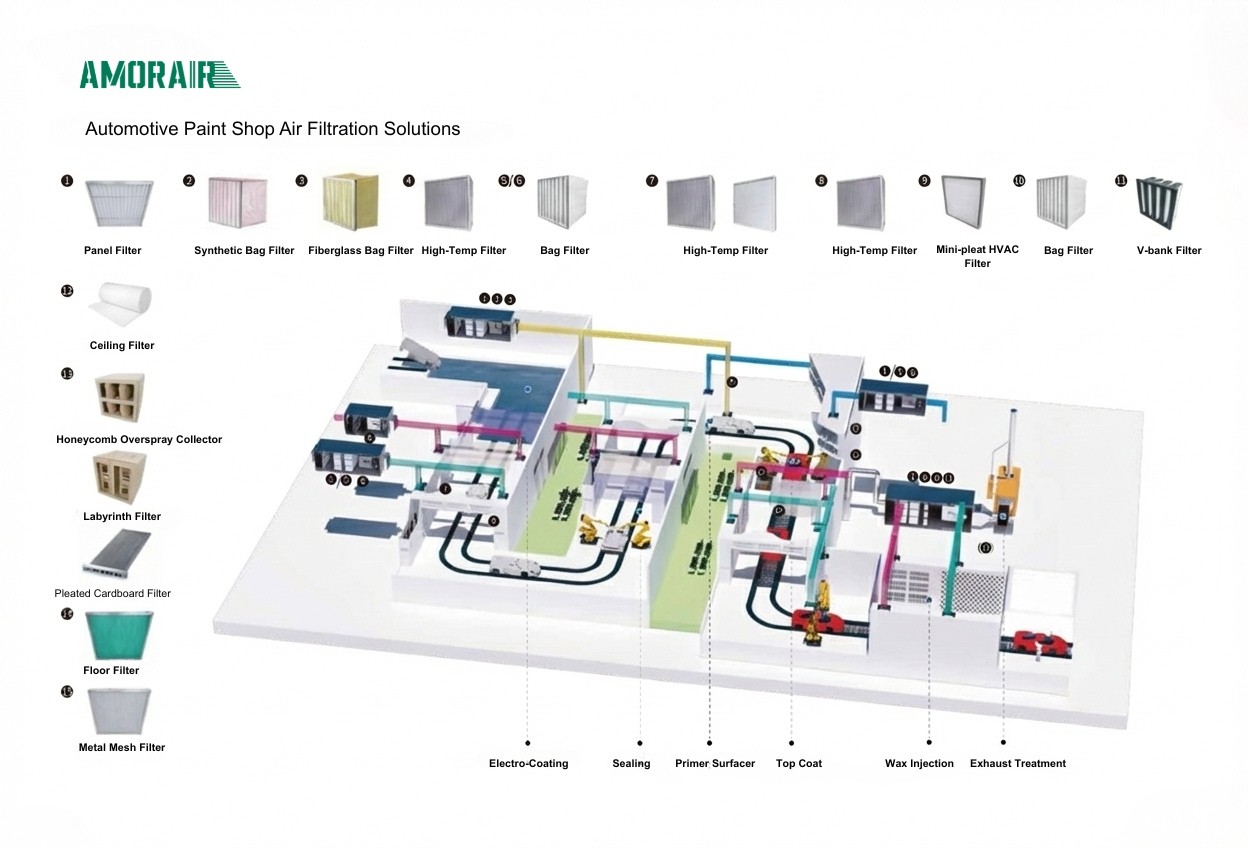
To troubleshoot finish issues, you must understand what each stage of filtration actually does. It is not just about catching dirt; it is about controlling air velocity.
Filter Stage | Media Type | Typical Efficiency | Core Function |
Pre-Filter (Intake) | G4/Merv8 Pleated | Coarse (captures >10μm) | Protects the expensive ceiling filters and the burner. |
Ceiling Filter(Diffusion) | F5/Merv10 w/ Scrim | Fine(captures >5μm) | Crucial: Creates "Laminar Flow" (uniform air speed) to prevent turbulence. |
Floor/Exhaust Filter | Fiberglass/ Polyester | Paint Arrestance (>98%) | Captures overspray mist to protect the fan and meet EPA regulations. |
A common misconception is that a ceiling filter is just a giant screen. It’s not. It is a diffuser.
If you use cheap, low-density ceiling media, you get "channeling." Air rushes through the path of least resistance, creating high-velocity spots and dead zones.It will result to turbulence. This turbulence kicks up floor dust and deposits it right onto your wet clear coat.
The solution: Use fully impregnated ceiling mediawith a rigid backing scrim. This forces air to pressurize the plenum and descend evenly over the vehicle—like a blanket of air.
Q1: Why do I have "Dust Nibs" (Dirt inclusions) in my finish?
This is usually Positive Pressure Failure. If your exhaust filters are clogged, the booth over-pressurizes. But if your intake/ceiling filters are loose or bypassed, dirty air is being sucked in. Check your ceiling filter frame seals—micro-leaks here are the #1 cause of nibs.
Q2: Why am I seeing "Die-back" (Loss of Gloss)?
It is often caused by Solvent Entrapment. If your floor/exhaust filters are loaded with overspray, airflow drops below the required FPM (feet per minute). Solvents can’t evacuate effectively, leading to a dull finish as it cures.
Q3: Why do I get 10-micron particles despite new filters?
Check for "Filter Shedding." Cheap, non-bonded fibers can break loose under air pressure. Always specify "continuously bonded fibers" or "scrim-backed" media to prevent the filter itself from becoming the contaminant.
Stop changing filters based on the calendar (e.g., "every 3 months"). That’s a rookie mistake. Production volume varies.
>>> Intake/Pre-filters: Change when visual discoloration reaches the intake side.
>>> Ceiling Filters: Change when the manometer (pressure gauge) hits the manufacturer's recommended final resistance (usually 400-450 Pa) OR if you see flow velocity drop below 0.25 m/s.
>>> Floor Filters: Change when overspray build-up restricts airflow, causing the booth pressure to spike.
A paint booth is a balanced ecosystem. Saving $50 on cheaper filters usually costs you $500 in labor hours for wet sanding and buffing. Amorair engineers filtration solutions that stabilize your booth's airflow, protecting your profit margins from the intake to the exhaust.
Is your booth struggling with airflow balance? Contact Amorair today. Stop guessing and start measuring. We can audit your current setup and recommend the exact media density your specific booth model requires.
Learn how a three-stage chemical filtration syst
Amorair provides semiconductor air filtration so
Eliminate "jet effects" and airflow dead zones i
Contact: +1(213)786-4191
Phone: +1(213)786-4191
Tel: +1(213)786-4191
Email: Info@amorairglobal.com
Add: 1476 W 9th St Upland, CA, United States 91786
 English


