In modern cleanrooms, hospitals, pharmaceutical factories, and other environments requiring high air quality standards, FFUs (Fan Filter Units) and HEPA filter terminal box are two commonly used air filtration devices. Although their ultimate goal is to provide clean air, they differ in both structure and application scenarios. Understanding their characteristics and applications is crucial for selecting the appropriate air filtration solution.
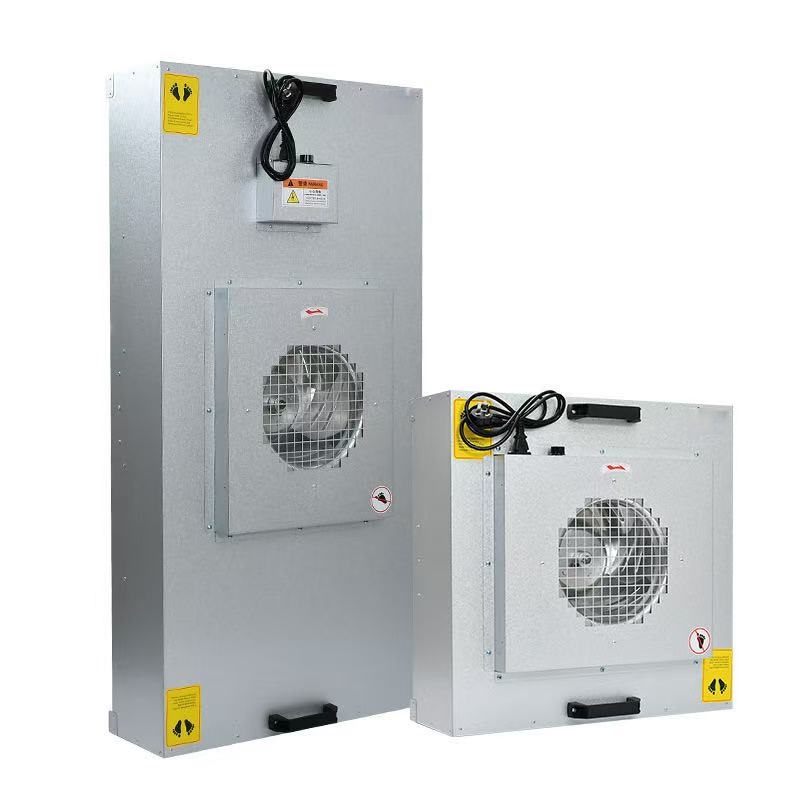
FFU (Fan Filter Unit), an air filtration device integrating a fan, HEPA/ULPA filters, and a controller. It is typically installed in a grid layout on the cleanroom ceiling. Its design aims to provide a continuous airflow while filtering airborne contaminants.
>>> Fan: Used to draw in outside air and propel it through the filtration system.
>>> Filter: Generally uses HEPA or ULPA filters to effectively remove airborne particles and contaminants. (Some products place a pre-filter before the HEPA filter.)
>>> Frame: Provides structural support and reduces noise.
>>> Control System: Adjustable fan speed to control airflow.
>>> Step 1: The FFU draws air from the room through its built-in fan, which enters the FFU through the air inlet.
>>> Step 2: The air passes through a pre-filter and a HEPA/ULPA filter, removing dust, bacteria, and other particulate matter.
>>> Step 3: The filtered air is discharged into the room through the air outlet, completing the air filtration process.
>>> High Efficiency and Energy Saving: The FFU effectively captures 99.95% of particles 0.3 microns and larger, ensuring the quality of air delivered to the cleanroom. Optimized fan and filter configuration improves airflow efficiency, resulting in energy savings.
>>> Uniform Airflow: The FFU's built-in fan ensures uniform and stable airflow, avoiding the imbalance problems of centralized air supply systems.
>>> Airflow Control: The FFU's airflow and on/off status can be quickly adjusted via a controller.
>>> Excellent Energy Efficiency: FFUs are small in size, easy to install and arrange, and particularly suitable for cleanrooms with limited space.
>>> Negative Pressure Ventilation: The static pressure box of the FFU air supply system is under negative pressure. Therefore, even if there is a leak at the air outlet, the leak is directed from the cleanroom to the static pressure box, preventing contamination of the cleanroom.
>>> Flexible Installation: FFUs are small in size, facilitating installation and arrangement. They are also modular and easy to replace with matching filters. They can be controlled by zones as needed and can be replaced or moved as required.
>>> Compared to ordinary air supply devices, although the energy-saving effect is significant in the long run, the initial investment cost is too high.
>>> FFU maintenance is relatively complex. Installed on the ceiling, the maintenance and replacement of filters and fans are relatively troublesome.
>>> The fan will produce noise during operation (this can be mitigated by using high-quality motors, but cannot be completely eliminated).
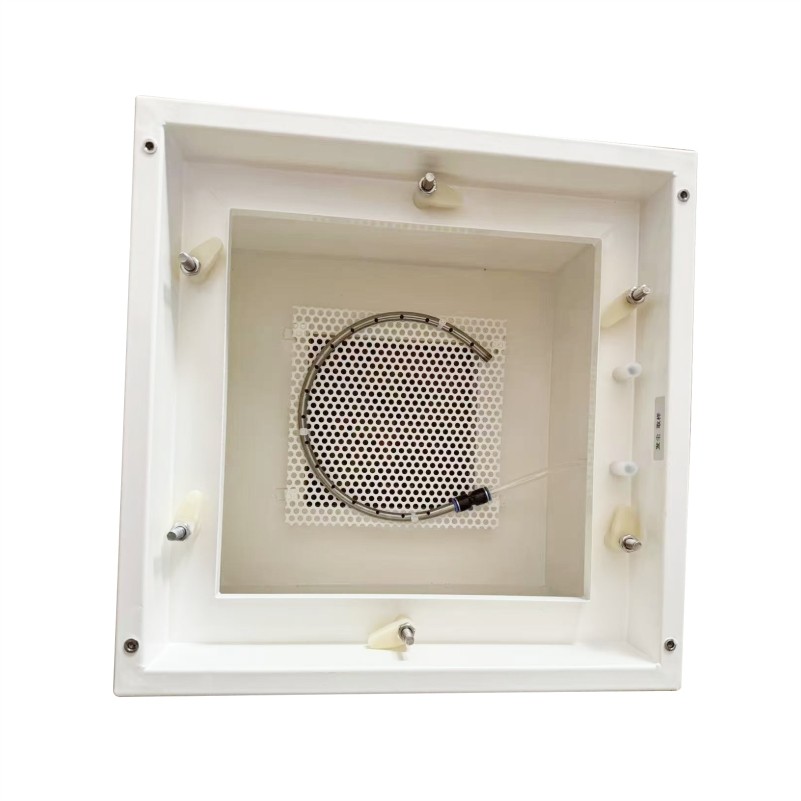
Like FFU (Fan Filter Units), HEPA filter terminal box is the most commonly used air supply and filtration device at the end of cleanroom operations. However, they are non-powered and require ductwork. The connection to the ductwork can be top-mounted or side-mounted.
>>> Static Pressure Box: The core component of the high-efficiency air supply outlet, it stabilizes airflow and provides sufficient static pressure to ensure the effective operation of the high-efficiency filter.
>>> HEPA Filter: Effectively filters dust particles from the air, ensuring the cleanliness of the supplied air.
>>> Diffuser: Used to guide the airflow evenly, achieving better diffusion during air delivery.
The working principle of the HEPA filter terminal box is that the HVAC system fan draws in air, which is then filtered through the HEPA filter to capture dust, bacteria, and other particles. The clean air is then delivered to the room through ductwork to ensure the cleanliness and hygiene standards of the indoor air.
>>> High-efficiency filtration: The built-in HEPA filter effectively captures 0.3-micron particles in the air, including dust, pollen, smoke, and bacteria.
>>> Customizability: Customizable to meet specific needs, such as size, airflow, and filter type.
>>> Durability and reliability: Features a robust frame, simple structure, and easy maintenance.
>>> Energy efficiency: Employs an energy-saving design, reducing operating costs while maintaining optimal air quality.
>>> There are many types of HEPA filter terminal box, and almost every air filtration equipment manufacturer has its own standards, making selection complex.
>>> Like FFU, HEPA filter terminal box is mainly used for cleanroom air filtration, but they cannot meet the requirements of Class 100 and Class 10 cleanrooms.
Based on the above analysis, we can get the following conclusions:
>>> Cost: FFU has a higher initial investment but lower operating costs. HEPA filter terminal box has a lower initial investment but are not as energy-efficient as FFU.
>>> Applications: Both can be used in cleanrooms of Class 1000, Class 10,000, and Class 100,000. However, FFU can meet the needs of Class 100 and Class 10 cleanrooms.
>>> Intelligence: FFUs have their own fans and controllers, allowing them to autonomously adjust airflow and on/off status, making them suitable for centralized air handling systems.
While FFU are currently the mainstream terminal air filtration equipment, when purchasing, you still need to balance efficiency and cost based on your actual needs, rather than blindly pursuing higher filtration efficiency. Amorair Global professionally provides FFU and HEPA filter terminal box. If you are still unsure how to choose, please feel free to contact us.
Learn how a three-stage chemical filtration syst
Amorair provides semiconductor air filtration so
Eliminate "jet effects" and airflow dead zones i
Contact: +1(213)786-4191
Phone: +1(213)786-4191
Tel: +1(213)786-4191
Email: Info@amorairglobal.com
Add: 1476 W 9th St Upland, CA, United States 91786
 English


